
What Ten Years in Indonesia Taught Me About the Ideas That Actually Survive
Let me start with a confession. I've had many good ideas. Hundreds of them. Ideas that would solve problems, make money, scale quickly. Ideas that looked brilliant on paper and died within months of touching reality. The difference between those ideas and th..

Let me start with a confession.
I've had many good ideas. Hundreds of them. Ideas that would solve problems, make money, scale quickly. Ideas that looked brilliant on paper and died within months of touching reality.
The difference between those ideas and the ones that survived wasn't creativity. It wasn't execution speed. It was something harder to measure: sustainability.
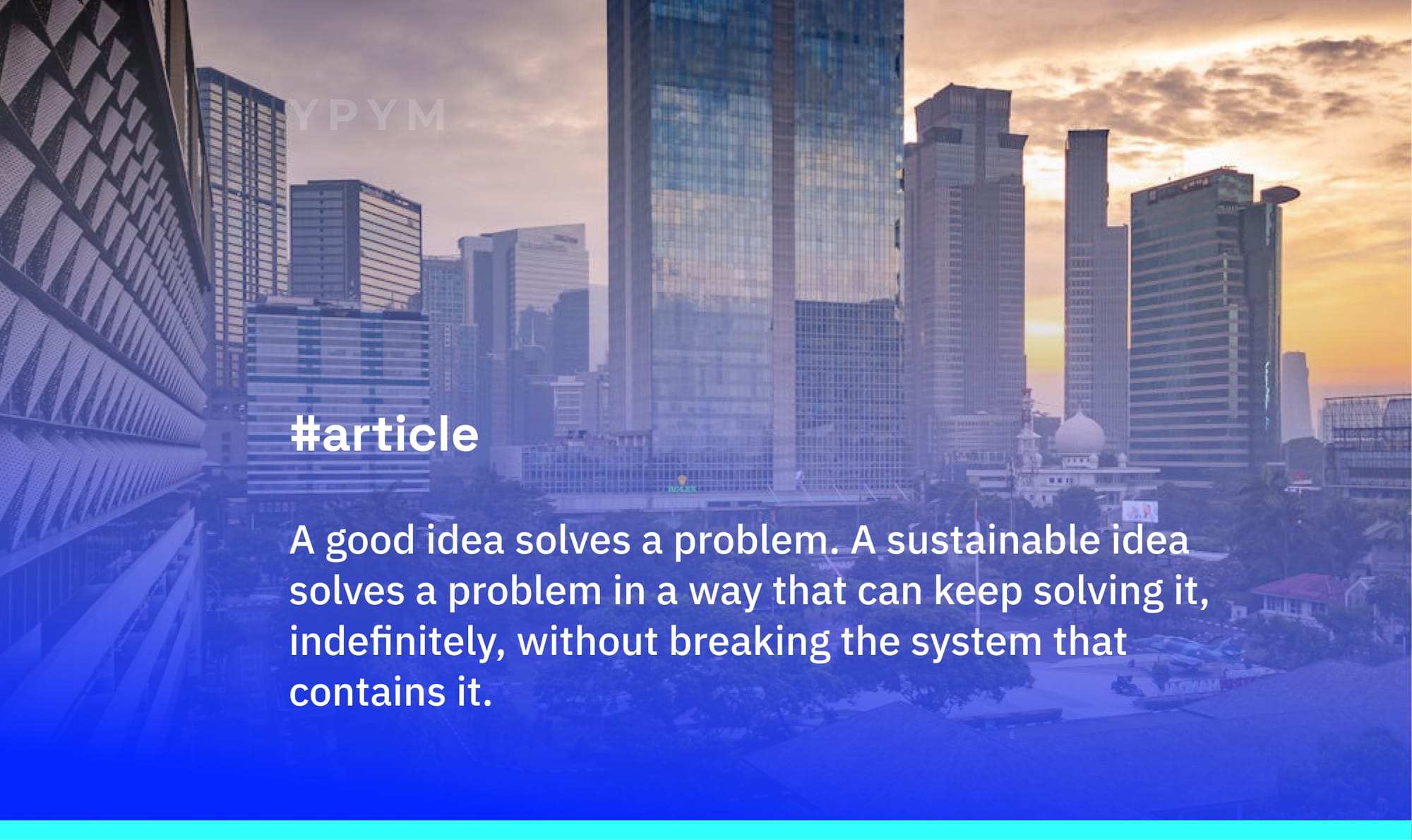
A good idea solves a problem. A sustainable idea solves a problem in a way that can keep solving it, indefinitely, without breaking the system that contains it.
Here's what ten years of watching Indonesia build has taught me about the difference.
The Arithmetic of Good Ideas
In my previous article, I wrote about the arithmetic of abundance, how the cost of building digital products dropped from 540 million to under 10 million rupiah. That arithmetic applies to ideas too.
Good ideas are abundant. They're everywhere. In 2025 alone, Padang & Co mapped 1,089 green economy startups across Southeast Asia, with Indonesia emerging as a central player in regional climate action due to its biodiversity and land-use profile .
A good idea in this landscape is table stakes. Everyone has one.
But here's what the mapping also shows: the main constraints are no longer innovation, but "the pace and scale of deployment"; fragmentation, slow adoption, and system bottlenecks across markets . In other words, good ideas are plentiful. Sustainable ideas are rare.
Southeast Asia's green economy cannot advance through innovation alone; we must build the systems, partnerships, and regulatory environments that allow solutions to scale. Source
This is the first lesson. A good idea solves a problem. A sustainable idea builds a system.
The Surplus Paradox
Consider Surplus Indonesia, a food-tech startup founded in 2020 during the pandemic. The good idea was obvious: reduce food waste. Indonesia discards an estimated 115-184 kilograms of food per person annually, resulting in approximately US$39 billion in economic loss even though this wasted food could feed 61 to 125 million people .


The good idea would have been a marketplace. Connect surplus food with hungry people. Simple.
But Surplus Indonesia built something more sustainable. They built an AI-powered inventory management tool that helps small business owners reduce losses, forecast surplus, and distribute products efficiently. They created a model where everyone wins: farmers who once discarded imperfect produce now see income increases of up to 30 percent, while consumers purchase quality products at discounts of up to 80 percent .
Everyone wins: businesses recover losses, consumers save money, and communities take part in sustainable consumption. Source
This is the difference. A good idea extracts value. A sustainable idea distributes it so broadly that the model becomes self-reinforcing.
The Lesson from Karawang's Rice Husks
In Karawang, one of Indonesia's major rice-producing regions, a team of educators saw something that most people missed. They saw piles of rice husks being burned by the roadside, creating pollution while farmers earned nothing from what they already had.
Their idea became BRISMA: aromatic briquettes made from rice husks, infused with essential oils to serve as mosquito repellents and therapy aids .
But here's what makes this sustainable, not just good. They didn't just create a product. They created a system.
They installed briquette machines directly in village centers. They buy rice husks directly from farmers, creating a new income stream. They train farmers to produce independently. In their pilot phase, they aim to train at least 60 farmers while selling 100-150 packs .
One of the most important lessons we've learned is that knowledge alone doesn't guarantee participation economic viability does. Farmers are willing to engage deeply when they see a tangible return. Source
This is the second lesson. A good idea teaches. A sustainable idea pays.
The Institutional Insight
Academic research confirms what these founders learned in the field. A systematic literature review of Triple Bottom Line implementation in Indonesian MSMEs found that stakeholder collaboration partnerships with firms like GoTo and Telkom, bridges resource gaps through digital training and IoT-driven agriculture .
MSMEs contribute 61% to Indonesia's GDP, yet struggle to adopt frameworks that balance environmental, social, and economic dimensions. Barriers include limited capital, technological access, and insufficient policy support .
The research argues for three policy interventions: green fiscal incentives, subsidized IoT adoption, and public-private mentorship programs . Because sustainable ideas don't exist in a vacuum. They require ecosystems.
The study positions MSMEs as pivotal actors in Indonesia's low-carbon transition, aligning their strategies with SDGs 8 (Decent Work), 9 (Industry Innovation), and 12 (Responsible Consumption). Source
The Composting Unit That Profits
In North Sumatra, the BIPOSC project built something remarkable: a Composting Unit that processes agricultural waste into organic fertilizer and sells it to smallholder farmers at one-third the market price .
The unit collects boiler ash from palm oil mills and manure from local cattle farms, materials that would otherwise go to waste. It employs trained workers. It produces 100 to 150 tons of compost per month. Over 40% of the smallholders in the project are active customers. More than 1,000 hectares of land are treated with this compost.
And in 2024, the composting unit turned a profit of over USD 31,000 .
This is not charity. This is not corporate social responsibility. This is a sustainable idea: a community-based circular economy initiative that generates income, creates jobs, adds value to waste, and can be replicated anywhere.
The Composting Unit addresses multiple barriers that have long hindered smallholder farmers. By providing high-quality organic compost at a fraction of the market price, it significantly lowers these barriers. Source
The Waste Bank Transformation
Research on Waste Bank Social Enterprises in urban Indonesia reveals a stark divergence. Most waste banks stagnate, trapped by a precarious aggregation-only model, collecting waste, selling it cheap, barely surviving.
But the rapidly scaling enterprises did something different. They made a strategic pivot: adopting value-adding processing. This transformation allowed them to exit the low-value commodity trap and secure stable, high-value industrial contracts .
Sustainable scaling is contingent upon a fundamental business model transformation from a passive collector to an active producer. This evolution from a community project to a market-integrated social enterprise is essential for financial resilience and amplifying social impact. Source
This is the third lesson. A good idea collects. A sustainable idea transforms.
The Scale Question
A full green transition in Southeast Asia could unlock up to USD $120 billion in economic value and create about 900,000 jobs by 2030, subject to continued investment .
But meeting the region's sustainability targets requires massive financing: US$1.5 trillion annually across Asia-Pacific and US$210 billion annually in Southeast Asia for climate-resilient infrastructure alone .
Encouragingly, 49% of investors surveyed plan to increase their allocations to Southeast Asia over the next five years. 94% of surveyed capital providers are investing in impact, with 92% directing funds toward digital sustainability .
The capital is there. The ideas are there. The question is which ideas are sustainable enough to receive it.
What I'm Still Learning
I started this article wanting to distinguish good ideas from sustainable ones. After ten years of watching Indonesia build, after collecting these stories and sitting with these numbers, here's what I think:
A good idea solves a problem for someone. A sustainable idea solves a problem for everyone, the farmer, the consumer, the environment, the next generation.
nerates revenue. A sustainable idea generates resilience.
A good idea is clever. A sustainable idea is patient.
Surplus Indonesia didn't just reduce waste; they increased farmer income by 30%. BRISMA didn't just make briquettes; they trained farmers to produce independently. The BIPOSC composting unit didn't just process waste; it turned a profit while building local resilience.
These are sustainable ideas. They survive because they serve. They scale because everyone in the system benefits. They last because they're built on economics, not enthusiasm.
The question I'm learning to ask myself, before chasing the next good idea, is not "is this clever?" It's "will this still be here in ten years?"
And if the answer is no, it wasn't a sustainable idea. It was just a good one.
— Rochman Maarif researches the intersection of search, governance, artificial intelligence, and institutional trust. He believes sustainable visibility is earned through stronger standards, better systems, and long-term authority, not short-term optimization.