



The Agent Will Always Call First. How Insurance's Oldest Distribution Model Still Owns the World, and Why That Is a Problem Nobody Is Solving
Let me start with something that took me an embarrassingly long time to say out loud. For most of my career inside one of Indonesia's largest general insurance companies, I believed that the agent was the product. Not the policy. Not the premium structure. No..

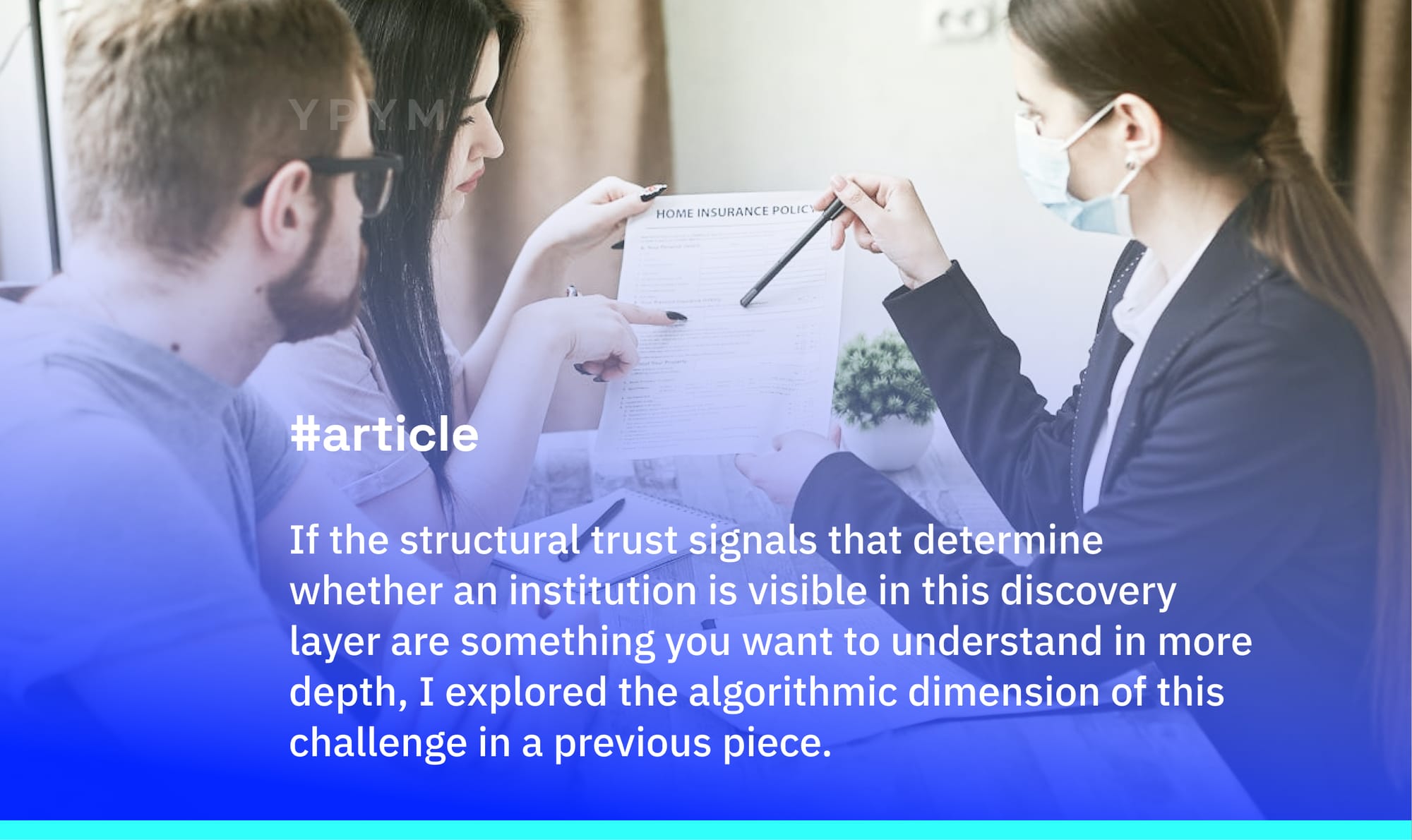
Let me start with something that took me an embarrassingly long time to say out loud.
For most of my career inside one of Indonesia's largest general insurance companies, I believed that the agent was the product. Not the policy. Not the premium structure. Not the claims ratio. The agent. The person who sat across the table from a prospect, who built a relationship over months before a single proposal was signed, who called on their birthday and remembered the names of their children. In a business built on the transfer of risk, the agent was the primary mechanism through which trust was manufactured and sold.
I was not wrong. But I was incomplete. And the incompleteness of that belief, held not just by me but by an entire industry across an entire continent, has created a structural gap that is now widening faster than most insurers are prepared to acknowledge.
This article is about that gap. It is about why the agent remains dominant, why that dominance is rational and defensible, and why the industry's comfort with that dominance has produced a blind spot in the discovery layer that precedes the agent's first call. Because the question the industry has never fully answered is not "how do we replace the agent?" The question is: how does a prospective customer decide to take that first call in the first place?
The Architecture of How Insurance Has Always Been Sold
If you have spent any meaningful time inside the insurance industry, the dominance of the agent channel is not a surprise. It is the water you swim in. What might be surprising is how structurally consistent this dominance has remained across geographies that differ in almost every other dimension.
In the United States, the world's most sophisticated insurance market by premium volume, the independent agency channel placed 61.5% of all property and casualty insurance written in 2024. That figure, published in the Big "I" 2025 Market Share Report, has held at a five-year average of 61.3%, showing almost no structural erosion despite decades of digital channel investment by direct writers and a sustained advertising arms race that has cost the industry billions. For commercial lines specifically, the number rises to 87.2%. Nearly nine in ten commercial insurance dollars in America still flow through an independent agent or broker.


This is the United States. A market with sophisticated consumers, deep insurance literacy, mature comparison platforms, and decades of digital distribution investment. And the agent still controls the dominant share.
In Indonesia, the picture is structurally similar but driven by entirely different underlying forces. Agents and brokers held 36.22% of the health insurance market share in 2025, and in motor insurance, agents and brokers accounted for 33.7% of total written premiums in 2024. These numbers do not capture the full picture, because in life insurance, the agent force is even more concentrated as a source of new business. The OJK's own industry roadmap acknowledges that the reach of insurance company marketing efforts remains one of the primary constraints on penetration growth, which is a diplomatic way of saying that distribution is still largely a human-to-human enterprise.
What is striking is not the similarity in the headline numbers across such different markets. What is striking is the similarity in the underlying logic.
Why the Agent Dominates: A Structural Explanation
The insurance industry's dependence on agents is not irrational. It is the correct response to the fundamental nature of what insurance is.
Insurance is an abstract product. You pay for something you hope never to use, to protect against an event that may never occur, governed by a contract that most buyers do not fully read. The product's value is entirely contingent on an institutional promise that will be tested, if ever, at a moment of maximum emotional vulnerability. A policyholder who discovers their claim is disputed, or excluded, or processed with delays, does not simply have a bad customer experience. They have a crisis.
In that context, the agent is not merely a distribution mechanism. The agent is the human interface that converts an abstract institutional promise into something a person is willing to pay for. The agent answers questions at 9pm. The agent follows up when the renewal slips. The agent explains why a particular clause matters for a particular life situation. No comparison website has yet replicated this function at scale, and the data suggests that even when consumers are capable of purchasing without an agent, many choose not to.
The J.D. Power 2025 Digital Experience Study found that 47% of auto insurance customers purchased through digital channels, while 35% still went through agents. This is often cited as evidence of digital channel growth. It is equally evidence that, in the category of insurance most amenable to digital purchase, simple, commodity-like, price-competitive, agents still hold more than a third of the market. For complex life, health, and commercial products, that proportion shifts materially further toward the human channel.
Southeast Asia amplifies this dynamic through additional cultural and structural layers. In Indonesia, the Philippines, Vietnam, and Thailand, the social fabric of financial decision-making is more collectivist than in Western markets. Financial decisions, particularly significant ones, are made in consultation with trusted networks: family, community leaders, colleagues. The insurance agent, when effective, inserts themselves into that trust network. They become the person whose opinion carries the weight of a warm referral. This is not unique to Southeast Asia, but it is more structurally embedded here, and more resistant to displacement by purely digital alternatives.
The Global Pattern: Agent Dominance Across Markets
The pattern holds with remarkable consistency across markets that otherwise have very little in common.
In Japan, one of Asia's most digitally sophisticated economies, life insurance distribution remains predominantly agent-driven, with face agents accounting for the majority of new policy acquisition. Japan Post Insurance, one of the country's largest life insurers, maintains an agent network embedded in the country's postal infrastructure. In South Korea, similarly, the personal sales channel has historically dominated, though bancassurance has grown significantly as banks integrated insurance cross-selling into their branch operations.
In India, the agent model is not merely dominant. It is constitutionally embedded in how the market functions. The Life Insurance Corporation of India, the country's largest insurer by far, operates through a field force of agents numbering in the millions. Individual agents often hold policies with several different insurers simultaneously, creating a distribution ecosystem that is simultaneously competitive and deeply relationship-driven.
In China, regulatory changes in recent years have reshaped the agent model, but the underlying principle remains intact: high-value insurance products in Asian markets flow primarily through human relationships, not digital interfaces. The regulatory restrictions that limited direct sales in China resulted in agency and bancassurance channels consolidating their dominance, precisely the opposite of what a simple digital-displacement narrative would predict.
In Europe, the picture is more varied by country. The UK and the Netherlands have developed sophisticated online comparison platforms that have genuinely shifted personal lines distribution toward digital. Germany, France, and Italy remain more agent-dependent for life and complex products. The pattern that emerges is consistent: digital channels capture price-sensitive, simple, commodity products. Complex, high-value, relationship-dependent products stay with the human channel.
The global insurance distribution market reached approximately $7 trillion in premium volume in 2024 and 2025, with agents and brokers maintaining the largest share at approximately 55%, even after declining from 65% five years earlier. Digital channels have more than doubled to exceed 15% in advanced markets, which is meaningful growth. But 55% versus 15% is not a transition. It is a snapshot of an industry that is changing at the margins while its structural center remains intact.
The Word-of-Mouth Mechanism and Why It Persists
One of the most consistent findings in insurance distribution research across markets is the role of referral and word-of-mouth as a source of new business. This is not surprising in theory. It is striking in practice, because it suggests that even in markets with sophisticated digital infrastructure, the most reliable path to an insurance purchase still begins with one person recommending another person to a third person they trust.
Inside the institution where I spent a significant portion of my career, we tracked this carefully. At the branch level, the referral rate was the metric that best predicted whether an agent was building a sustainable book of business or simply chasing one-off transactions. Agents who generated high referral volumes were typically those who had also delivered clean claims experiences, who had stayed in contact beyond the point of sale, and who had positioned themselves as ongoing advisors rather than transactional vendors.
The referral is a compression mechanism. It collapses the trust-building timeline from months to a single conversation. A prospect who receives a referral from someone they trust enters the agent relationship at a different starting point than a cold prospect. They arrive with a provisional transfer of credibility that the agent needs only to confirm, not establish from scratch.
This dynamic plays out identically across Indonesia, Southeast Asia, the US, and every other market where insurance is sold. The referral network is the invisible infrastructure of insurance distribution. And it operates almost entirely offline, in conversations that leave no digital trace.
The Discovery Gap Nobody Is Filling
Here is where the structural analysis leads to a conclusion that, for most of my career, I would not have known how to articulate.
The agent is the mechanism of sale. The referral is the mechanism of trust transfer. But before either of these operates, there is a prior stage that the industry has systematically underinvested in: the moment of awareness and initial research that precedes any human contact whatsoever.
In Indonesia today, 230 million people use the internet. Insurance penetration remains at approximately 1.4% of GDP. The gap between these two numbers is not primarily a distribution problem. The agent force exists. The products exist. The regulatory framework exists. The gap is, in significant part, a discovery problem. People who should be buying insurance are not finding the education, the clarity, or the institutional credibility that would lead them to seek out an agent in the first place.
Search engines are where people go when they are beginning to understand something. "What is term life insurance?" "Do I need health insurance if I already have BPJS?" "How does property insurance work in Indonesia?" These are not purchase queries. They are education queries, and they represent the stage of the customer journey that happens before the agent ever makes contact.
The institution that owns this discovery layer does not replace the agent. It feeds the agent. It ensures that when a prospect finally picks up the phone or responds to an outreach message, they arrive with a baseline of product understanding that makes the conversation more productive, the relationship easier to establish, and the close more likely.
Most insurance companies in Indonesia, and across Southeast Asia, do not own this layer. Their digital presence exists to service existing customers and to provide corporate information to institutional counterparties. The educational content that would capture a prospective customer at the research stage is either absent, poorly structured, or optimised for no one in particular.
The agent calls first. But something has to prompt the prospect to be willing to take that call. The institution that understands this is not building a digital sales channel in competition with its agents. It is building a digital education infrastructure that makes its agents more effective at exactly the moment when a prospect has moved from awareness to consideration.
What the US Market Teaches About This Gap
The United States offers a useful benchmark, not because the market is directly comparable to Indonesia or Southeast Asia, but because it is further along in the evolution this region is beginning to experience.
The independent agency channel's 61.5% share of US P&C premiums is not simply a legacy artifact of how insurance has historically been distributed. It is an active, competitive result. Direct writers, who have invested billions in digital channels and brand advertising, have not fundamentally displaced the independent agent model. What has happened instead is a bifurcation: digital channels dominate simple personal lines for price-sensitive consumers, while agents maintain their position in complex, high-value, and commercial segments.
More importantly for this discussion, the US market has also developed a sophisticated ecosystem of insurance education and comparison content that functions as a feeder for both channels. Consumers who arrive at an independent agent having already researched their options online are better-qualified prospects who close faster and retain longer. The digital discovery layer and the agent distribution layer operate in a complementary relationship, not a competitive one.
This is the architecture that does not yet exist in Indonesia and most of Southeast Asia. Not because the agent model is wrong. Because the discovery infrastructure that should precede and support the agent model has not been built.
The Penetration Gap as a Discovery Problem
Indonesia's insurance penetration at 1.4% of GDP is frequently discussed as a distribution problem or a product problem. I want to offer a different frame.
The insurance literacy rate in Indonesia reached 31.72% in 2022, up from 19.40% in 2019, according to OJK's own national literacy survey. This is meaningful progress. But the insurance inclusion rate, the proportion of people who actually hold an insurance product, was 16.63% in the same year. There is a 15 percentage point gap between people who have some literacy about insurance and people who have actually purchased it.
That gap is not primarily a product gap or an agent access gap. It is a trust and education gap. People who understand insurance in the abstract have not been provided with a credible, trustworthy, accessible path to the specific product knowledge that would move them from literacy to purchase.
Search is that path for an increasing proportion of the population. And the institutions that are not building credible, authoritative, algorithmically sound digital education infrastructure are ceding that path to whoever is willing to build it, which in the Indonesian context increasingly means comparison aggregators, fintech platforms, and insurtech startups whose interests are not necessarily aligned with the long-term policyholder relationships that traditional insurers have spent decades building.
The agent will still close the sale. That is not changing in any timeframe that matters for current strategic planning. But the agent's territory is being encircled by a discovery layer that traditional insurers did not build and do not control. Every prospect who forms their initial understanding of insurance through a third-party aggregator is a prospect whose first institutional relationship is with that aggregator, not with the insurer.
What Structural Discovery Investment Actually Looks Like
I want to be precise about what this is not, because the misconception is common.
Building a discovery layer for insurance is not a content marketing programme. It is not publishing weekly blog posts about insurance tips. It is not social media. These things exist in a different category of effort and produce different categories of result.
A structural discovery investment in the insurance sector means building educational architecture that is designed to be found by people who are asking specific questions at specific moments in their research journey, structured in a way that satisfies the elevated quality standards that search engines apply to financial content, authored by people with verifiable institutional credentials, and maintained with the same rigour that an institution applies to its regulatory disclosure obligations.
It means treating the digital discovery layer as an institutional asset, not a marketing function. It means applying the same governance discipline to public-facing educational content that a compliance team applies to product disclosure documents. Because in the eyes of a search engine evaluating financial content for quality and trustworthiness, those two things are part of the same institutional record.
For an insurer with a deep agent force and a strong referral network, this investment does not cannibalise existing channels. It extends their reach into the discovery stage that currently belongs to no one, or to platforms whose interests diverge from the insurer's own.
The agent will always call first. But the institution that ensures its brand, its products, and its educational content are what a prospect finds before that call is the institution that controls the context in which the agent's first conversation takes place.
That context is the territory worth building. And almost no insurer in this region has started.
If the structural trust signals that determine whether an institution is visible in this discovery layer are something you want to understand in more depth, I explored the algorithmic dimension of this challenge in a previous piece. The question of how Google evaluates financial institutions for credibility is not separate from the distribution strategy discussed here. It is the technical foundation that determines whether the discovery infrastructure you build is actually found by the people you are trying to reach.
You can read that analysis here: The Algorithm Knows You're Not Ready: What Google's Trust Framework Actually Means for High-Stakes Brands in Asia
— Yuliana Kusumawati is a financial services strategist with a career spanning management to director-level leadership in Indonesia's general insurance sector.