



The Question Every Business Owner Asks. And The Framework We Built to Answer It.
When you pitch SEO services to a business owner, they don't ask "How many keywords will you rank for?" They ask: "How much return will I get from investing in SEO?" It's a straightforward question. It's also one most SEO agencies cannot answer with precision...

When you pitch SEO services to a business owner, they don't ask "How many keywords will you rank for?"
They ask: "How much return will I get from investing in SEO?"
It's a straightforward question. It's also one most SEO agencies cannot answer with precision.
The Problem With "Potential Traffic"
Most agencies cite potential traffic volume. They point to search volumes from a keyword gets 5,000 monthly searches, so theoretically, you could capture some fraction of that. They then extrapolate that if you rank in position 3, you might get 20% of traffic, so you could expect 1,000 visits per month.
Then they invoice for their services.
The disconnect is obvious. The business owner didn't ask how many visitors the website might get. They asked, what is the financial return from this investment? Those are different questions entirely.
Traffic volume is an intermediate metric. What actually matters is conversion; How many of those visitors become customers? What is the average value per customer? What is the total revenue attributable to organic search from this specific keyword? And how does that compare to the cost of achieving that ranking position?
This is the question we set out to systematically answer.
Building a Framework from Market Data
For the past few weeks, YPYM's research and development team has been working to construct a framework that estimates return potential at the keyword level before any SEO work begins.
The logic is simple. The execution requires data integration across multiple sources.
Step 1: Keyword as Primary Key
Every analysis begins with a single keyword. This keyword becomes the reference point for all subsequent data collection. We normalize it, identify variants, and establish its semantic relationship to user intent.
Step 2: Search Market Data (Google Ads)
The first data source is the search volume and competitive landscape data provided by Google Ads. This includes:
- Monthly search volume (aggregated across geographies and time periods)
- Competition index (how many advertisers are bidding on this keyword)
- Bid range (low-range and high-range cost per click for paid search)
- Trend data (how has search volume changed over the last 3 months, and year-over-year)
Why Google Ads data? Because Google controls 90%+ of search market share globally. Their data reflects actual user behavior at scale. The CPC (cost per click) data, while meant for paid search, is actually a proxy for keyword value in the market. If advertisers are willing to pay $15 per click on a keyword, that keyword has commercial intent. If they're only willing to pay $0.50 per click, the intent is lower, conversion probability is lower, and the keyword's commercial value is lower.
Step 3: Interest and Momentum Data (Google Trends)
The second data source is Google Trends. This provides:
- Interest index (how much relative interest does this keyword have compared to baseline)
- Geographic distribution (which regions are searching for this keyword)
- Temporal patterns (is interest growing, stable, or declining)
- Related queries (what are users searching for in the same intent cluster)
Google Trends operates in real-time. It refreshes daily. For our purposes, it's the most reliable interest indicator available in the public domain.
Step 4: Demand Validation (Google Suggest)
The third data source is Google's search suggestions, the queries that appear in the search box when you start typing. This is the fastest-published, most current data Google provides. It reflects:
- Actual user behavior (which variations of the keyword are people actually searching for)
- Top queries (the most common variations)
- Rising queries (which variations are gaining momentum)
Google Suggest updates continuously. It's the closest thing we have to real-time demand data for any keyword.
The Integration: From Data to Insight
Once we have data from these three sources, we integrate them to answer the original question: What is the return potential from investing in SEO for this specific keyword?
The framework considers:
Commercial Intent Strength
- Is this a keyword people are actively paying for in Google Ads?
- What is the bid range, and what does that imply about conversion value?
- Is interest in this keyword growing, stable, or declining?
Market Opportunity
- How many people are searching for this keyword monthly?
- What is the distribution of intent are these mostly informational queries or commercial/transactional?
- Are there geographic concentrations that matter for your business?
Feasibility and Timeline
- How competitive is this keyword?
- Based on current SERP positioning, how difficult is it to rank?
- What is the realistic timeline to achieve ranking positions that generate meaningful traffic?
Return Projection
- Based on search volume, conversion probability, and average order value, what is the estimated annual revenue attributable to this keyword?
- What is the cost of achieving ranking positions that generate that revenue?
- What is the ROI?
Simplicity by Design
This framework sounds complex. It's actually the opposite.
We built it specifically so business owners and the SEO professionals advising them, don't have to ask too many questions. You input a keyword. The system pulls data from multiple sources. It integrates the data. It returns an estimate.
No black boxes. No theoretical extrapolations. Data from the market, integrated logically, presented simply.
Introducing YPYM Appraisal
This framework is now live as a product. It's called YPYM Appraisal, and it's accessible at https://appraisal.ypym.app.
The tool is free to use. No signup required for basic queries. The output is a straightforward report that shows:
- Keyword demand (monthly search volume, trends, geography)
- Commercial intent (bid range, competition, conversion probability)
- Return potential (estimated annual revenue based on ranking positions)
- Investment requirement (estimated cost to achieve ranking positions)
- ROI (return per dollar invested in SEO)
For YPYM members and research partners, we offer deeper analysis. This includes:
- Keyword cluster analysis (how this keyword relates to other keywords in your target market)
- Competitive benchmarking (what are competitors doing with similar keywords)
- Timeline modeling (month-by-month projection of traffic and revenue as you improve ranking positions)
- Budget allocation framework (how to allocate SEO budget across multiple keywords to maximize overall ROI)
Why This Matters
This framework makes SEO investment transparent. It moves the conversation from "we'll improve your rankings" to "here is what improved rankings are worth financially, and here is what it costs to achieve them."
For businesses, this means you can make informed decisions about SEO investment. You can compare SEO ROI to other marketing channels. You can justify budget allocation to finance and executive teams.
For SEO professionals, this means you can have credible conversations with clients. You're not making claims about traffic potential, you're showing market data that validates your strategy. You're not quoting services based on effort, you're quoting based on market value and your efficiency in capturing it.
For YPYM, it represents what we've been building toward: moving from "here's what good SEO looks like" to "here's precisely what good SEO is worth, and here's how we deliver it."
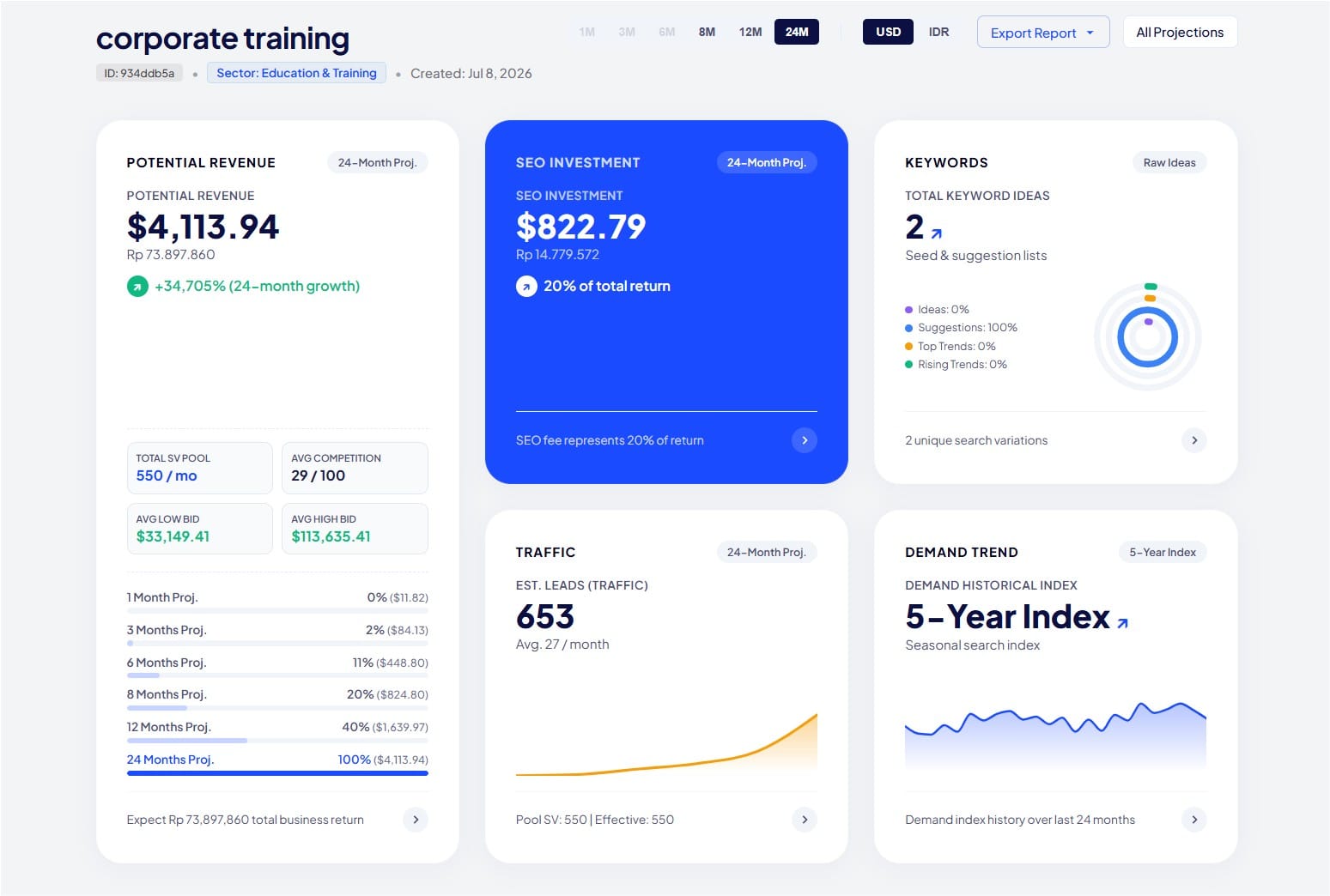
Try YPYM Appraisal: Go to https://appraisal.ypym.app, enter a keyword relevant to your business, and see what the framework reveals about market opportunity and return potential.
Marketing Technology (MarTech) YPYM Product Suite
For deeper research: If you want cluster analysis, competitive benchmarking, or timeline modeling, email [email protected]. We're actively working with partners to refine and expand this framework.
Context: YPYM Appraisal is part of a broader product suite from YPYM Flow, YPYM Web Sitemap, YPYM Query Mapping, all built around a single principle - make SEO decisions transparent and data-driven. No guesswork. No theater. Just market data, integrated logically, presented simply.
The question "How much return will I get from investing in SEO?" is not unanswerable. It just required us to build the framework to answer it.
We built it. It's available now.
Test it. Let us know what you find.