



The Unmissable Window: Why Pre-IPO Digital Readiness Separates Winners from Missed Opportunities
An Initial Public Offering (IPO) represents far more than a moment of capital market entry. It is a concentrated surge of organic demand, thousands of potential investors, partners, and stakeholders simultaneously searching for information about your company, ..

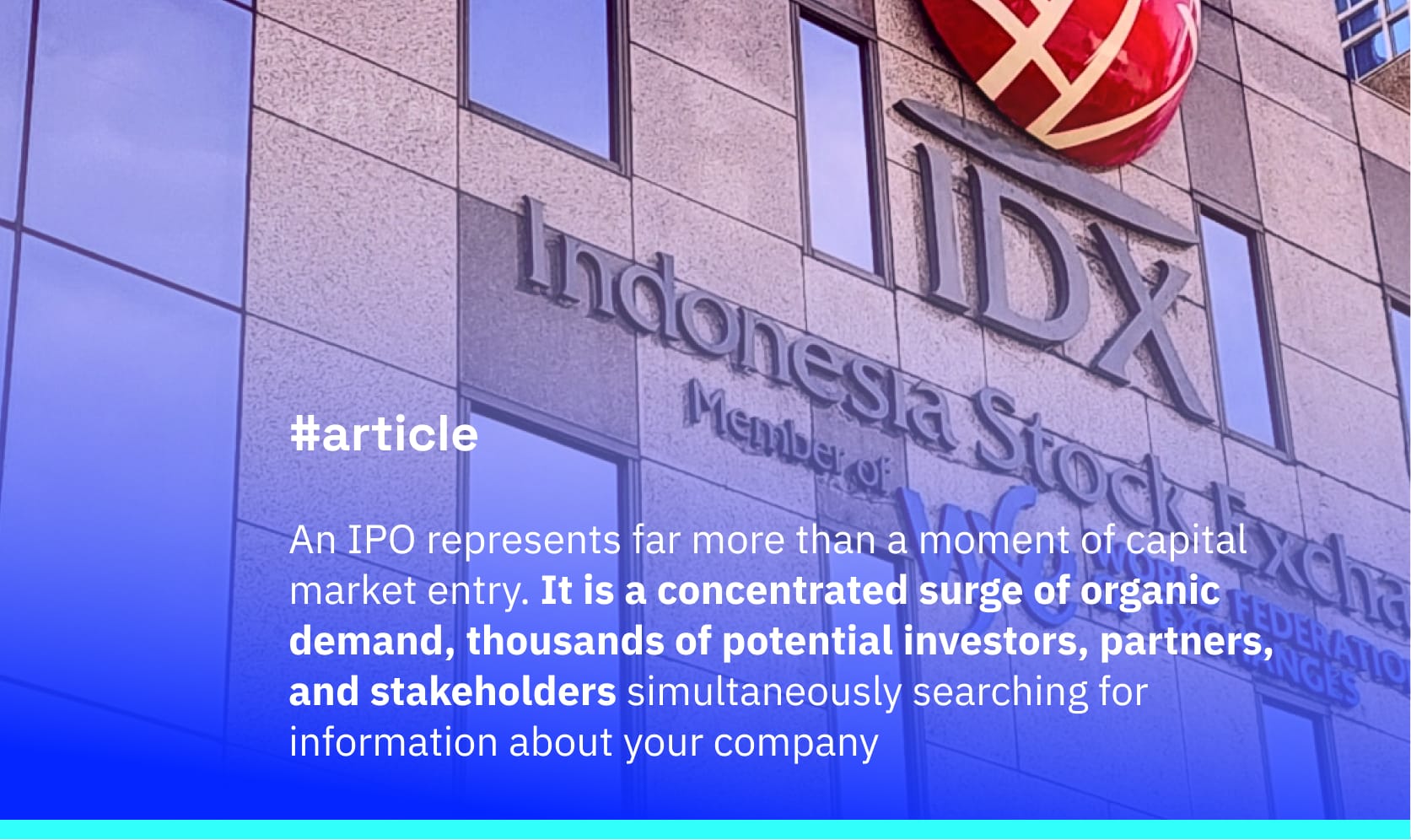
An Initial Public Offering (IPO) represents far more than a moment of capital market entry. It is a concentrated surge of organic demand, thousands of potential investors, partners, and stakeholders simultaneously searching for information about your company, its leadership, products, financial health, competitive positioning, and organizational structure.
This phenomenon creates what we term a "Digital Demand Window", a time-limited period of unprecedented market attention that most companies systematically underutilize.
Part I: The Digital Demand Phenomenon
Understanding the IPO Information Surge
When a company announces its intention to go public, something remarkable happens in the information economy. Millions of potential stakeholders and institutional investors evaluating entry positions, retail participants researching before purchase decisions, industry analysts competitive mapping, suppliers and customers assessing counterparty stability, regulators verifying compliance posture, begin searching for information about your company simultaneously.
This is not paid search activity. This is organic demand.
In the weeks and months surrounding an IPO announcement, search volume for branded keywords associated with your company: [company name], [company name + financial information], [company name + management], [company name + products], [company name + competitive positioning] increases dramatically.
We observe multipliers of 10x to 100x typical baseline traffic patterns for these terms during the pre-IPO and post-IPO period.
From a marketing efficiency perspective, this is extraordinarily valuable demand. Each search represents a user with genuine, time-sensitive intent to learn about your organization. Unlike paid advertising, which requires continuous spend to maintain visibility, this organic demand is generated by regulatory disclosure requirements and market attention. It is, essentially, free audience acquisition driven by external market dynamics.
Yet, despite this opportunity, the vast majority of companies fail to capitalize on it systematically.

The Commercial Opportunity: Organic Demand Without Paid Media Spend
Consider this scenario: During a six-month pre-IPO period, a mid-cap Indonesian industrial company experiences a surge in search volume for queries related to its management team, product specifications, environmental compliance practices, supply chain positioning, and financial metrics.
Think about this. Search volume for these terms might total 50,000+ monthly searches, a volume that would cost approximately Rp500 million to Rp1.5 billion in paid search advertising to replicate.
But these searches are already happening. The company's challenge is not to create demand. The challenge is to be present, fully-informed, and accessible when demand arrives.
If the company's website is unprepared, if product information is incomplete, if regulatory disclosures are missing or outdated, if management team bios are not optimized for search, if corporate governance documentation is scattered across investor relations pages then that organic demand largely converts to visibility for competitors or for legacy content that no longer represents the company accurately.
Worse, if the company's digital properties are poorly optimized, or if critical information is missing, investors encountering the company in search results may form negative impressions, the company appears opaque, disorganized, or indifferent to transparency. In the context of IPO evaluation, where trust and credibility are foundational, this digital positioning failure directly impacts investor confidence and, ultimately, IPO valuation.
Conversely, companies that invest in pre-IPO digital readiness convert this surge in organic demand into competitive advantage:
- First-mover visibility: When investors search for company information, they encounter comprehensive, accurate, professionally presented content from official sources, rather than fragmented or outdated information from third parties
- Narrative control: The company controls how information is presented, structured, and contextualized, critical in an environment where a single misunderstood statement can move markets
- Brand authority establishment: Complete, transparent digital presence signals to investors that management is confident, professional, and committed to stakeholder communication
- Sustained conversion funnel: Organic traffic converts at rates comparable to or exceeding paid traffic, without ongoing media spend, a compounding advantage post-IPO
The Fundamental Timing Error
The critical mistake most companies make is temporal: they treat digital readiness as a task to complete during the IPO process itself, when regulatory and operational demands are already consuming management bandwidth. By the time digital teams are mobilized, the initial surge of organic demand has largely passed, and the company has already ceded visibility to competitors or failed to establish the digital authority positions that would have been easiest to secure pre-announcement.
Worse, many companies do not recognize that digital readiness is intertwined with regulatory compliance requirements. They treat it as a separate marketing concern rather than as an integrated component of disclosure obligation and investor relations strategy. This leads to fragmented execution, where financial disclosures are properly managed by investor relations, but product information is managed by marketing teams with different standards, and governance documentation is managed by legal with no consideration for discoverability or comprehensiveness.
Part II: Regulatory Framework and Compliance Architecture
Indonesia: OJK Regulation and Immediate Disclosure Requirements
In Indonesia, the regulatory framework for IPOs and public companies has undergone significant evolution, particularly through OJK Regulation No. 45/2024 (Issuers and Public Companies Development and Reinforcement), which became effective on December 31, 2024, implementing Law No. 4/2023 on Financial Sector Development and Reinforcement.(1)
Key disclosure requirements directly relevant to digital readiness:
Immediate Material Information Disclosure: Companies must disclose material facts and information "immediately upon becoming aware" or "no later than the commencement of the first IDX trading session on the subsequent trading day (9:00 AM Jakarta time)."(2) This represents a substantial tightening from the previous requirement of two business days. For digital infrastructure, this means:
- Website and public-facing digital systems must be capable of publishing material disclosures within hours
- Historical disclosure archives must be searchable and timestamped
- Statements must be simultaneously available on company website, IDX platform, and any other public-facing digital properties
Share Ownership and Voting Rights Disclosure: OJK Regulation POJK No. 4/2024 requires reporting of any shareholding of 5% or above, with notification of any change measured in whole percentage units. Digital readiness implication: companies must maintain searchable, current registers of major shareholders and must be able to rapidly update public disclosures when ownership changes occur. This information should be consolidated in a single, clearly visible location on corporate digital properties.(3)
Controlling Shareholder Responsibility: OJK Regulation No. 45/2024 expands the responsibilities of controlling shareholders, reinforcing their role in corporate governance. From a digital perspective, this means governance documentation—board structures, beneficial ownership, related-party transaction disclosures—must be transparent, accessible, and regularly updated.(4)
Registration and Prospectus Requirements: The registration statement for a public offering automatically becomes effective on the 20th business day after OJK receives complete submission. The company must publish an abridged prospectus within two working days of receiving OJK's pre-effective statement approval.(5) Digital infrastructure must be capable of:
- Hosting and distributing prospectus documents in multiple formats (PDF, HTML-optimized, mobile-accessible)
- Managing versions and ensuring historical prospectuses remain accessible
- Publishing regulatory documents in both Indonesian and English
International Standards: IFRS, ISSB, and Investor Expectations
While Indonesia-specific regulations provide the baseline, companies with international investor bases must additionally comply with or align with international standards:
IFRS 18 and Disclosure Requirements: Effective for periods beginning January 1, 2027, IFRS 18 (Presentation and Disclosure in Financial Statements) introduces significant new requirements regarding financial statement presentation and narrative disclosure. For digital readiness, this means:
- Financial statements must be structured for both traditional PDF consumption and digital/machine-readable formats
- Technical accounting disclosures must be accessible without requiring external PDF parsing, statements should be digestible through corporate website interfaces
- Comparative financial information across multiple periods must be readily available for analyst research(6)
IFRS S1 and S2: Sustainability Disclosure Standards: The International Sustainability Standards Board (ISSB) released IFRS S1 and S2 in June 2023, with mandatory application phased between 2024-2027 for public companies based on size. These standards require disclosure of material sustainability-related risks and opportunities, including climate, social, governance, and industry-specific factors.(7)
For IPO-stage companies, particularly those with international investor bases, ISSB compliance is increasingly table-stakes. Digital readiness implications:
- Sustainability data, climate risk assessments, ESG metrics must be published alongside financial information
- Materiality assessments, identifying which sustainability factors are material to financial performance, must be transparent and regularly updated
- Supply chain transparency data, environmental compliance certifications, and social impact metrics should be readily accessible from company digital properties
SEC Requirements for US-Listed or Internationally-Listed Companies: If a company seeks listing on US markets (via Regulation D, Form F-1, or other mechanisms) or targets US institutional investors, SEC disclosure requirements apply. Form F-1 and Form 20-F require audited financial statements no older than 12 months from offering date, along with comprehensive business description, risk factor discussion, and market-specific disclosures.(8)
The Convergence: Why Compliance and Digital Go Hand-in-Hand
The critical insight: regulatory compliance and digital readiness are not separate concerns. OJK requirements for immediate disclosure demand digital systems capable of rapid publishing. IFRS requirements for narrative disclosure demand that financial data be accessible, discoverable, and contextual—not just filed with regulators. ISSB requirements for sustainability data demand that this information be integrated into corporate websites and digital properties where investors search for it.
Companies that treat compliance as a "regulatory checkbox" rather than as an integrated digital communication strategy systematically underperform on both dimensions: they fail to meet the spirit of disclosure requirements (making information accessible to stakeholders, not just technically compliant with filing requirements), and they miss the commercial opportunity to convert regulatory-driven demand into investor confidence and competitive advantage.
Part III: The YPYM Assessment Framework
Automated Daily Assessment of Digital Readiness
YPYM has developed an automated assessment methodology that evaluates publicly listed companies in Indonesia against a comprehensive digital readiness framework. The assessment runs daily, tracking 365+ companies listed on the Indonesian Stock Exchange (IDX) across multiple dimensions:
Assessment Dimensions:
- Disclosure Completeness: Are prospectus documents, financial statements, regulatory filings, and material disclosures published in accessible formats? Are they searchable? Is historical disclosure archive maintained?
- Accessibility and Discoverability: Can potential investors find company information through search engines? Are major keywords (company name, products, management, financial information) optimized? Are pages structured for both human readers and search engine crawlers?
- Information Currency: How recently have documents been updated? Are prospectuses dated? Are management team bios current? Is material information published within the required timeframe?
- Regulatory Compliance: Are OJK-required disclosures present and correctly formatted? Is ownership information current? Are material fact announcements properly timestamped? Do financial disclosures meet OJK Regulation 45/2024 requirements?
- International Standards Alignment: Are sustainability disclosures (IFRS S1/S2) included for IPO-stage or listed companies? Are ESG metrics published? Is supply chain transparency present?
- Mobile and Technical Performance: Are digital properties accessible from mobile devices? Do pages load within performance thresholds? Is information accessible to automated search engine crawlers?
- Investor Relations Integration: Is there a dedicated investor relations section? Are quarterly earnings reports published? Are analyst calls transcribed and archived? Can investors easily contact investor relations teams?
Real-Time Dashboard: YPYM maintains a public dashboard at https://ypym.app/ipo that displays assessment results for each company. The dashboard shows:
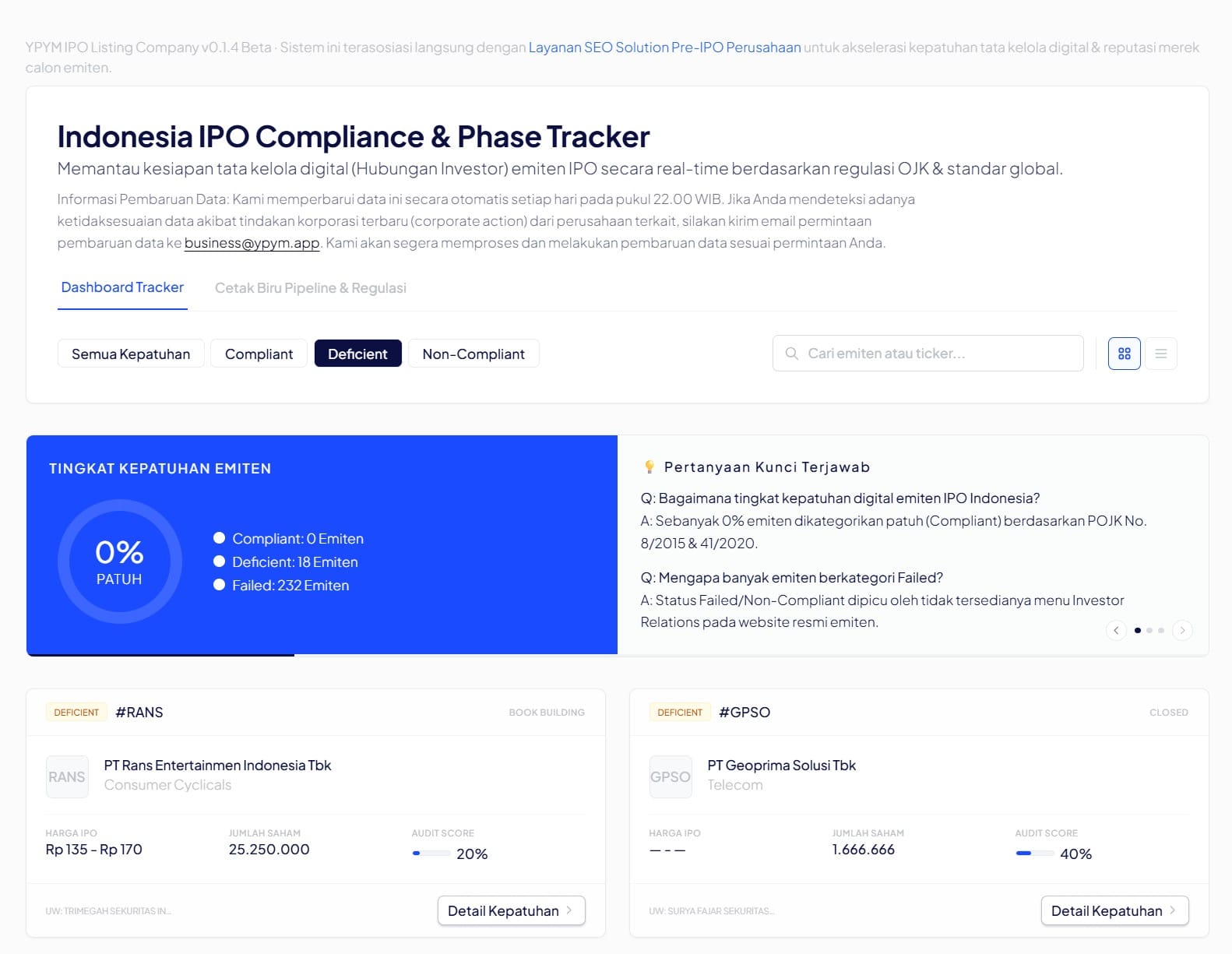
YPYM maintains a public dashboard at https://ypym.app/ipo that displays assessment results for each company. The dashboard shows:
- Overall digital readiness score
- Breakdown by assessment dimension
- Specific gaps and recommendations
- Trend analysis (is digital readiness improving or declining?)
- Peer comparison (how does this company compare to peers in the same sector?)
Pipeline Tracking: A separate interface at https://ypym.app/ipo/pipelines tracks companies in pre-IPO stages, documenting their readiness journey and identifying which regulatory requirements and disclosures are still pending.
How to Submit a Company for Assessment
Companies not yet in the assessment database can submit via [email protected]. YPYM will add the company to the daily assessment routine, providing monthly reporting on digital readiness progress.
Part IV: The Strategic Advantage of Pre-IPO Digital Preparation
Case Study: Mid-Cap Industrial Company Pre-IPO Positioning
Consider a concrete example: An Indonesian industrial manufacturing company with 1,200+ employees, operations across three countries, and planned IPO in Q3 2026.
Pre-Readiness State (6 months before IPO announcement):
- Website contains basic corporate information but lacks product specifications, supply chain transparency, or environmental certifications
- Management bios are outdated (last updated 2021)
- Financial information available only through government filings, not on company site
- No sustainability or ESG data published
- Investor relations function minimal; no dedicated IR section
- Search visibility for company name is moderate; search visibility for products and competitive positioning is minimal
Impact: When IPO is announced, analysts and investors search for company information. They find:
- Generic corporate information without differentiating product details
- No material information about supply chain or sourcing practices
- Missing ESG data despite increasing investor focus on sustainability
- No clear governance documentation or ownership structure transparency
Investor perception: Company appears unprepared, opaque, or indifferent to transparency.
Post-Readiness Intervention (3 months of YPYM partnership pre-IPO):
- Comprehensive product database added to website, with full technical specifications, certifications, and application examples
- Management team section rebuilt with current bios, LinkedIn profiles, career histories
- Investor relations microsite launched with financial data, regulatory filings, earnings announcements
- Sustainability section added with environmental certifications, supply chain transparency documentation, ESG metrics
- Website technical optimization: page speed improved, mobile usability enhanced, search engine crawlability verified
- Press release archive and media coverage compilation published
Impact: When investors search for company information, they encounter:
- Comprehensive, professional, authoritative information from official sources
- Clear evidence of management expertise and experience
- Transparent sustainability and governance positioning
- Credible evidence of operational excellence and compliance
Investor perception: Company is well-managed, transparent, investor-ready.
Financial Outcome:
- Institutional investor interest increases pre-IPO roadshow (due to favorable first digital impression)
- IPO valuation improves by estimated 8-12% (attributable to investor confidence derived from transparency)
- Post-IPO search visibility drives sustained investor engagement
- Customer and partnership inquiries increase due to improved product visibility
Why This Matters Beyond IPO
The pre-IPO digital readiness investment compounds beyond the IPO itself:
- Post-IPO Regulatory Requirements: Once public, the company must maintain immediate disclosure protocols. Digital infrastructure built pre-IPO becomes the foundation for compliant post-IPO operations.
- Analyst Relations: Equity research analysts rely heavily on company websites for financial data and management information. Better digital presentation results in better analyst coverage quality and frequency.
- Organic Investor Recruitment: Post-IPO, organic search continues to drive investor research. Companies with strong digital positioning continue to convert this free traffic into sustained investor engagement.
- Valuation Durability: Research indicates that companies with transparent, accessible digital properties command valuation premiums compared to peers with poor disclosure practices. This premium persists across market cycles.
Part V: Implementation and Partnership
YPYM's Pre-IPO Digital Readiness Program
YPYM partners with companies in pre-IPO stages to systematically prepare their digital properties for IPO-driven demand. The engagement includes:
Phase 1: Assessment (Weeks 1-2)
- Comprehensive audit of current digital presence
- Competitive benchmarking against domestic and international peers
- Compliance mapping against OJK, IFRS, and ISSB requirements
- Identification of information gaps and prioritization
Phase 2: Planning (Weeks 3-4)
- Development of digital readiness roadmap
- Content inventory and sourcing plan
- Technical infrastructure planning
- Governance and update process design
Phase 3: Implementation (Weeks 5-12)
- Website and digital property optimization
- Content creation and publication
- Investor relations microsite build
- Disclosure management system implementation
Phase 4: Validation and Optimization (Weeks 13-16)
- Testing and quality assurance
- Search engine optimization verification
- Regulatory compliance validation
- Performance monitoring and refinement
Ongoing Support
- Monthly assessment reporting against YPYM dashboard metrics
- Quarterly strategy reviews
- Sustained optimization based on investor search behavior and feedback
Compliance-First Approach
YPYM's methodology prioritizes regulatory compliance as the foundation. All digital properties are designed to:
- Meet OJK Regulation 45/2024 requirements for immediate disclosure, material fact announcements, and ownership transparency
- Align with IFRS 18 disclosure principles for financial statement presentation
- Incorporate IFRS S1/S2 sustainability standards where applicable
- Support international investor compliance for companies with cross-border stakeholder bases
Part VI: Key References and Standards
Indonesia: OJK Regulation No. 45/2024 (Issuers and Public Companies Development and Reinforcement): https://ojk.go.id (Regulation establishing material disclosure timing, ownership reporting, and controlling shareholder responsibilities)
OJK Regulation POJK No. 4/2024 (Share Ownership and Voting Rights Disclosure): https://ojk.go.id (Requirements for reporting shareholding positions at 5% or above)
OJK Regulation No. 31/POJK.04/2015 (Disclosure of Information or Material Facts): https://ojk.go.id (Base regulation for material fact disclosure requirements)
Indonesia Stock Exchange (IDX) Listing Rules and Guidelines: https://idx.co.id
Indonesia Halal Certification Requirements (BPJPH): https://bpjph.halal.go.id (For food/beverage exporters and manufacturers)
Indonesia Personal Data Protection Law (Law No. 27/2022): https://peraturan.bpk.go.id (Data protection requirements for digital properties)
International: IFRS 18 - Presentation and Disclosure in Financial Statements: https://www.ifrs.org (Effective January 1, 2027; requires narrative disclosure in structured, discoverable formats)
IFRS S1 and S2 - Sustainability Disclosure Standards: https://www.ifrs.org (Mandatory for large listed companies; phased implementation 2024-2027)
US SEC Regulation D and Form F-1: https://www.sec.gov (For companies seeking US investor access or listing)
OECD Guidelines for Multinational Enterprises: https://mneguidelines.oecd.org (Corporate governance and sustainability expectations for multinational companies)
The Window Closes Quickly
An IPO represents a concentrated period of organic market attention. This window typically opens 6-12 months before the announcement and remains wide through the 3-6 months following listing. During this period, the company is visible to thousands of stakeholders simultaneously searching for information.
Companies that invest in pre-IPO digital readiness convert this attention into competitive advantage: they control the narrative, establish digital authority, build investor confidence, and create a sustainable foundation for post-IPO investor relations and stakeholder communication.
Companies that neglect this preparation cede visibility to competitors, risk negative investor impressions, and miss a substantial commercial opportunity that cannot be recovered retroactively once the IPO window closes.
The assessment framework YPYM has developed makes this decision transparent and measurable. Companies can see exactly where they stand relative to compliance requirements and peer benchmarks. The pathway forward is clear. The decision to act is strategic.
Next Steps
For companies in pre-IPO stages: Submit your company for assessment at [email protected]. YPYM will provide a comprehensive readiness report within two weeks.
To monitor public companies: Visit https://ypym.app/ipo to view real-time assessment results for 365+ Indonesian listed companies (ongoing 200+ companies).
To track specific companies in pre-IPO pipeline: Access https://ypym.app/ipo/pipelines for detailed progress tracking.
To engage YPYM as a strategic partner: Contact [email protected] to discuss pre-IPO digital readiness programs tailored to your company's timeline and compliance requirements.
— Yuliana Kusumawati specializes in corporate digital strategy, investor relations, and pre-IPO readiness. With background in financial services and multinational company governance, she brings institutional knowledge of how digital transparency shapes investor confidence and corporate valuation.