



Is Your DXP Actually Built for AI Search? Adobe vs Sitecore vs Optimizely
Before this one, my colleague Yuliana wrote about the question buyers almost never ask before signing a DXP contract, what the platform actually costs once implementation, integration, and specialist fees are added to the license fee. You can read that piece h..

Before this one, my colleague Yuliana wrote about the question buyers almost never ask before signing a DXP contract, what the platform actually costs once implementation, integration, and specialist fees are added to the license fee. You can read that piece here (in Bahasa Indonesia): /blog/harga-lisensi-dxp-vs-total-cost-of-ownership
This piece picks up a different question from the same buying conversation, one that has become almost unavoidable in every DXP evaluation call I have sat in during 2026, can this platform actually get our content cited by ChatGPT, Gemini, or Perplexity, not just ranked on Google?
The honest answer is that this question used to be unanswerable, because most vendors had nothing concrete to point to beyond a marketing slide with the word "AI" on it.
That has changed faster than most procurement teams realize. Adobe, Sitecore, and Optimizely have each shipped actual product modules built specifically for AEO (Answer Engine Optimization) and GEO (Generative Engine Optimization) in the past year. Not roadmap promises. Shipped features with documentation, release notes, and pricing tiers.
So let's open the hood on all three, and then ask the harder question at the end: whether owning a DXP is even still the right framing for this problem, or whether the market has quietly moved somewhere else entirely.
Adobe / AEM: Brand Visibility (formerly LLM Optimizer)
Adobe's entry into this space started as a standalone product called LLM Optimizer, which has since been folded into a broader offering called Adobe Brand Visibility, combining Adobe's own optimization engine with Semrush's market intelligence data.
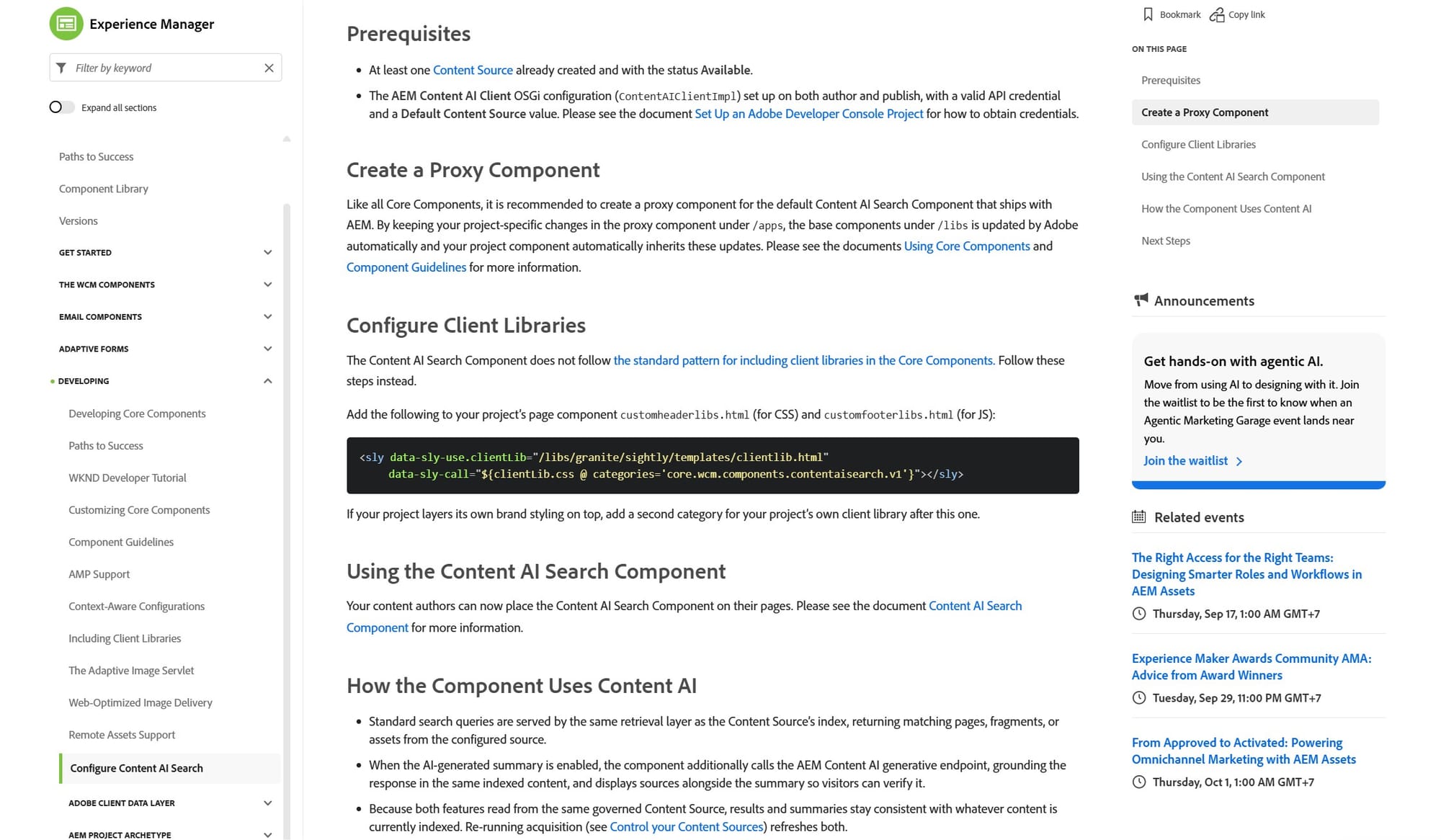
The technical premise is straightforward once you see it: traditional SEO tools measure where you rank in a search results page. Brand Visibility measures whether, and how, AI systems mention, cite, or represent your brand when someone asks a question in ChatGPT, Microsoft Copilot, Perplexity, or Google AI Mode. It does this by running structured prompts through those systems, tracking citation frequency, and surfacing the specific content gaps that are keeping a brand out of the answer.


What makes this more than a monitoring dashboard is the fix layer sitting behind the measurement. Adobe's documentation describes automated resolution of technical GEO issues, including blocked crawlers, missing structured data, and 404 errors, without needing an engineering ticket.
That last point matters more than it sounds. In most enterprise CMS environments, fixing a missing schema.org markup or an accidentally blocked crawler directive requires a developer, a sprint ticket, and a deployment window. Adobe is positioning this as something a marketing or SEO team can trigger directly from inside the same interface where they already manage content, with rollback available if the change causes an unexpected side effect.
The product also closes the loop on attribution. GEO performance is wired directly into Adobe Analytics and Customer Journey Analytics, which means a content team can, in principle, trace a specific optimization back to actual engagement or revenue impact, rather than reporting an abstract "visibility score" with no connection to business outcomes.
Sitecore: The AEO/SEO Researcher Agent
Sitecore's approach lives inside SitecoreAI, the unified platform the company consolidated its product line into during late 2025. The specific module relevant here is the AEO/SEO Researcher, described in Sitecore's own documentation as an agent that audits how a website performs across both traditional SEO and AEO contexts simultaneously.
What the agent actually evaluates is more granular than a simple audit checklist. Per Sitecore's documentation, it scores a site across semantic signals (how clearly the site communicates meaning to both search engines and AI systems), E-E-A-T and brand authority signals (verified authorship, transparent sourcing), and produces something Sitecore calls an "AI citation forecast," an estimate of how likely a page is to actually get referenced by ChatGPT, Copilot, or Gemini.

This forecasting layer is the part worth paying attention to technically, because it implies Sitecore has built some model of what these LLMs tend to reward when selecting sources, rather than just checking for the presence of schema markup. Running the agent requires a Builder License, and its output includes a weighted summary showing which factors are dragging the score down most, alongside a direct recommendation list.
Sitecore backs this product decision with independent architectural guidance published separately from the sales copy. Its technical documentation recommends server-side rendering, static generation, or incremental regeneration specifically so that AI crawlers receive complete HTML rather than a JavaScript shell they cannot parse, and it explicitly recommends storing headings, FAQs, and metadata in structured content fields rather than burying them inside unstructured rich text blocks. https://www.sitecore.com/resources/insights/artificial-intelligence/designing-content-for-ai-discovery
That architectural point is the one most vendors gloss over. A CMS can ship every AEO feature imaginable, but if the front end renders content client-side with JavaScript, an AI crawler that does not execute a full browser session simply never sees the content in the first place. Sitecore stating this explicitly, rather than assuming customers will figure it out, is a meaningful signal about how seriously they are treating the technical layer underneath the marketing layer.
Optimizely: The GEO-Ready CMS and Opal Agents
Optimizely made the most explicit public claim in this category, announcing what it called the first "GEO-ready CMS" in mid-2025, built around the premise that AI agents do not browse a page the way a human does. They scan it.
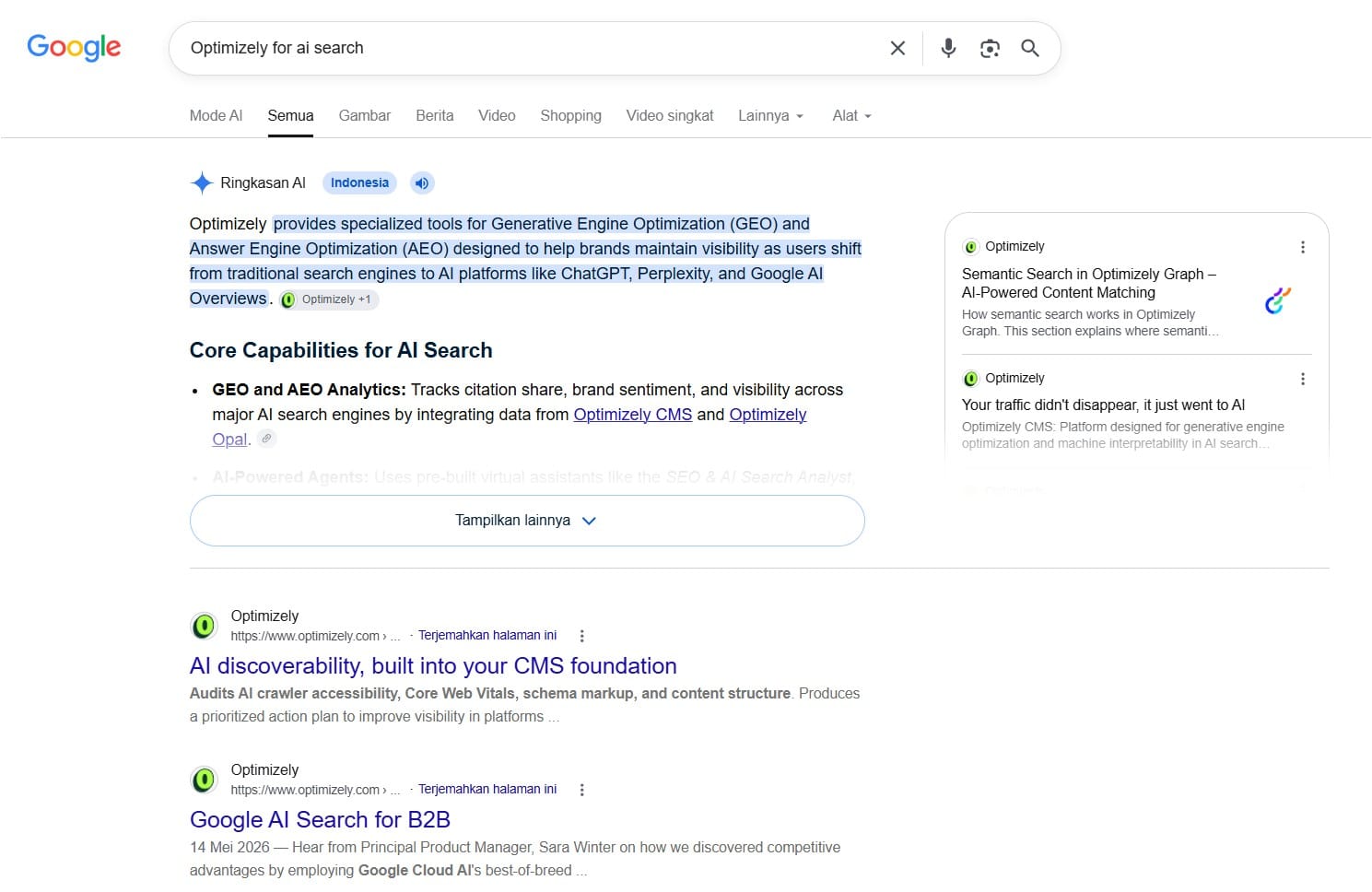
The feature set is the most granular of the three when it comes to content authoring workflow. Optimizely's CMS includes automatic Q&A field generation, which produces question-and-answer pairs directly from existing page content, GEO-specific metadata generation for titles, descriptions, and E-E-A-T elements, and markdown summary injection intended to make pages easier for an LLM to scan and index without needing to parse full HTML.
Sitting on top of the CMS is Optimizely Opal, the company's AI agent layer, which in its most recent release notes describes a GEO Auditor agent that produces a full report covering AI crawler accessibility, Core Web Vitals, schema markup, content structure, and citation readiness, along with a prioritized action plan.
The same release notes describe a GEO Schema Optimization feature that automatically identifies structured data opportunities across existing CMS content, which is functionally similar to what Adobe offers, but delivered as an agent workflow rather than a standalone audit tool. Optimizely also publishes its own definition of GEO through its optimization glossary, treating the discipline as a natural extension of the CMS product rather than a bolt-on service.
Side-by-Side: What Each Platform Actually Ships
| Capability | Adobe (Brand Visibility) | Sitecore (SitecoreAI) | Optimizely (Opal / CMS) |
|---|---|---|---|
| Native AI citation tracking | Yes, across ChatGPT, Copilot, Perplexity, Google AI Mode | Yes, via AI citation forecast | Partial, via Profound Citation Gap Analysis integration |
| Automated technical fix (no engineering ticket) | Yes, one-click GEO fixes with rollback | Not explicitly documented as one-click | Yes, via GEO Schema Optimization agent |
| Structured Q&A field generation | Not the core focus | Recommended via structured fields, not auto-generated | Yes, automatic Q&A field generation |
| Rendering guidance for AI crawlers | Not the core focus | Yes, explicit SSR/SSG recommendation | Implied via Core Web Vitals audit |
| Revenue/analytics attribution | Yes, native Adobe Analytics integration | Not explicitly documented | Not explicitly documented |
| Requires separate license/tier | Yes (Brand Visibility is its own product line) | Yes (Builder License) | Bundled into CMS + Opal subscription |
| Competitive benchmarking | Via Semrush market intelligence | Via AEO/SEO Researcher | Via Profound Citation Gap Analysis |
None of the three platforms are weak here. All three have moved past marketing language into shipped, documented product modules. The differentiation is really about where each vendor chose to put its engineering effort: Adobe leaned into measurement and revenue attribution, Sitecore leaned into architectural correctness and citation forecasting, Optimizely leaned into content authoring automation at the field level.
The Harder Question: Are DXPs Still the Right Frame?
Here is where I want to push back on the premise a little, because I think it is the more interesting conversation.
Google's own documentation, published in 2026, makes a point that cuts against the entire AEO/GEO tooling industry that has emerged around this topic.
Google states plainly that structured data is not required for generative AI search, that there is no special schema.org markup needed for it, and that llms.txt files and AI-specific content chunking are not necessary either.
Its position is that optimizing for generative AI search is, from Google Search's perspective, still just optimizing for the search experience, and thus still SEO.
That is a meaningfully different claim from what all three DXP vendors are implicitly selling.
If Google's own AI features are rooted in the same core ranking and quality systems as regular search, relying on retrieval-augmented generation and query fan-out across the existing search index, then a large part of what determines AI visibility was already determined by whether your fundamental SEO was solid, long before any GEO-specific tooling existed.
This does not make the DXP-native AEO/GEO features useless.
Being cited by ChatGPT or Perplexity involves different retrieval mechanics than Google's index, and Sitecore's point about server-side rendering is a real, concrete technical requirement that has nothing to do with Google specifically, since a crawler that cannot execute JavaScript cannot read your content regardless of which AI system it belongs to. What it does suggest is that some portion of what is being sold today as new GEO capability is closer to correctly implemented SEO fundamentals with a new label attached, and buyers evaluating these platforms should ask vendors to be specific about which claimed features solve a genuinely new technical problem versus which ones repackage a problem that a well-run SEO program should have already solved years ago.
The question worth asking in a vendor demo, then, is not "do you have GEO features." All three answer yes. The better question is: which of your GEO features fix something that would not have been fixed by disciplined, fundamental SEO practice already, and can you show me the mechanism, not just the dashboard.
Where This Leaves a Buying Decision
If your organization is already deep into content operations on Adobe, Sitecore, or Optimizely, none of the three vendors are behind on this. Each has built genuine, documented tooling, not vaporware. The choice between them on AEO/GEO grounds alone should probably come down to where your team's actual gap sits: Adobe if you need the tightest connection between AI visibility and revenue reporting, Sitecore if your priority is getting the underlying content architecture and rendering strategy correct at the foundation, Optimizely if your bottleneck is authoring speed and you want AI-ready fields generated automatically as content gets created.
But the TCO conversation from the previous piece and this AEO/GEO conversation are, in the end, the same conversation. A platform with excellent GEO tooling still needs the implementation budget, the specialist hours, and the architectural discipline to actually use that tooling correctly. Buying the feature is not the same as operationalizing it. That gap, more than any single feature comparison, is usually where the real difference between platforms shows up eighteen months after the contract is signed.
— Rochman Maarif, YPYM Partner and SME owner. I like my theories complex and my jokes simple. I'd rather test an idea than debate politics - discovery is way more fun than drama.
Reference:
- Yuliana Kusumawati, Harga Lisensi DXP Cuma Puncak Gunung Es. Ini Biaya Sebenarnya (YPYM) –
https://ypym.app/blog/tco-dxp-bukan-cuma-harga-lisensi - Adobe Brand Visibility (formerly LLM Optimizer) (Adobe Business) –
https://business.adobe.com/products/llm-optimizer.html - Adobe Brand Visibility Overview (Adobe Experience League) –
https://experienceleague.adobe.com/en/docs/llm-optimizer/using/essentials/overview - Introducing Adobe Brand Visibility: A Unified GEO Platform (Adobe Business Blog) –
https://business.adobe.com/blog/introducing-adobe-llm-optimizer - AEO/SEO Researcher (Sitecore Documentation) –
https://doc.sitecore.com/sai/en/users/sitecoreai/aeo-seo-researcher.html - What Is Answer Engine Optimization (AEO)? A Guide to AI Discovery for Enterprise Marketing (Sitecore) –
https://www.sitecore.com/resources/insights/artificial-intelligence/designing-content-for-ai-discovery - Optimizely Announces First GEO-Ready CMS for AI-Powered Discovery (Optimizely Press) –
https://www.optimizely.com/company/press/geo - 2026 Optimizely Opal Release Notes (Optimizely Support) –
https://support.optimizely.com/hc/en-us/articles/37791100847373-2026-Optimizely-Opal-release-notes - Generative Engine Optimization (GEO) Definition (Optimizely Glossary) –
https://www.optimizely.com/optimization-glossary/generative-engine-optimization-geo - Optimizing Your Website for Generative AI Features on Google Search (Google Search Central) –
https://developers.google.com/search/docs/fundamentals/ai-optimization-guide