
On Building Information Architecture Before the Audience Arrives
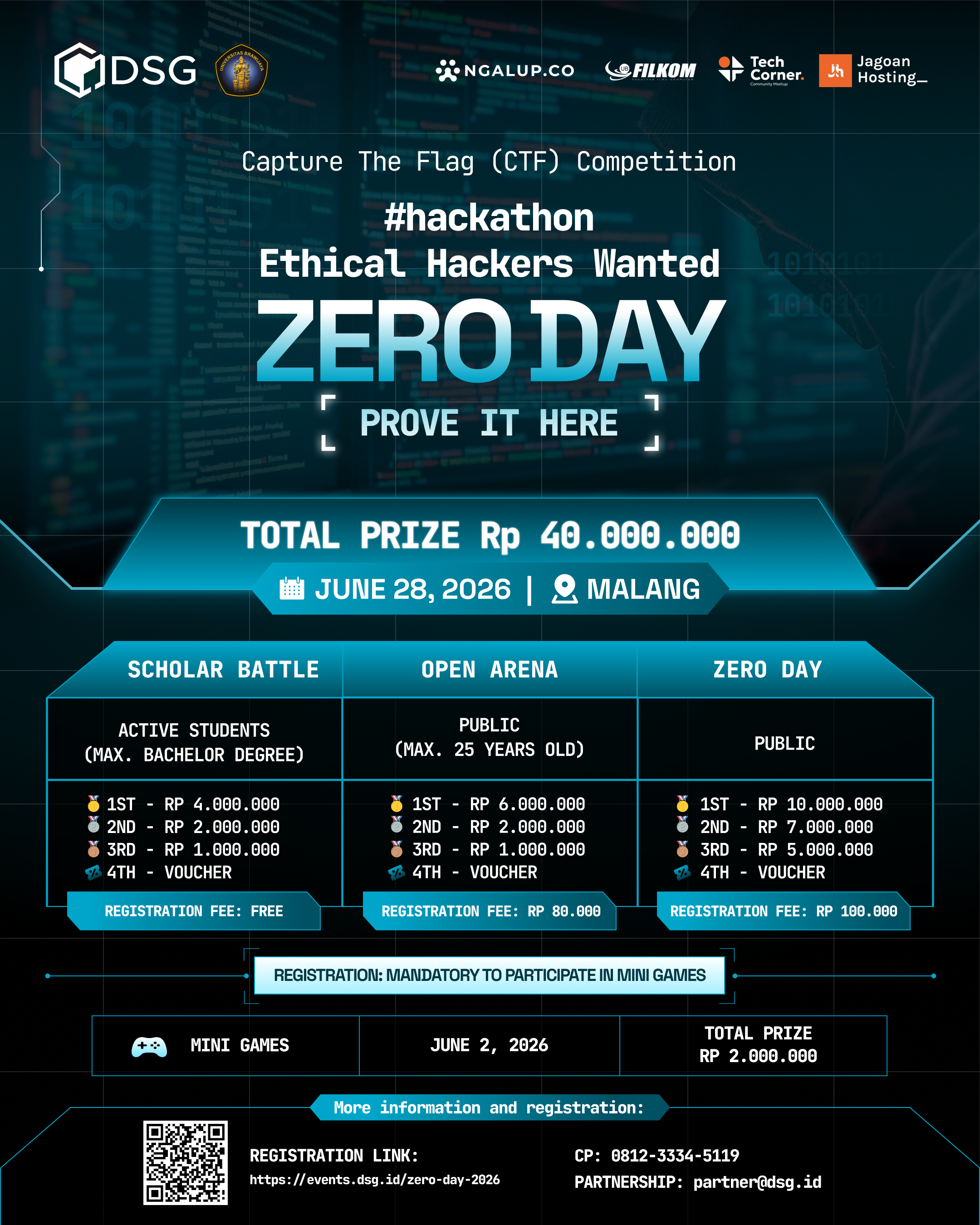
Today we activated the mini games stage for Zero Day 2026, a national Capture the Flag competition organized by DSG, open to students and the general public across all skill levels. It is a cybersecurity event with a total prize pool of Rp40 million, targetin..

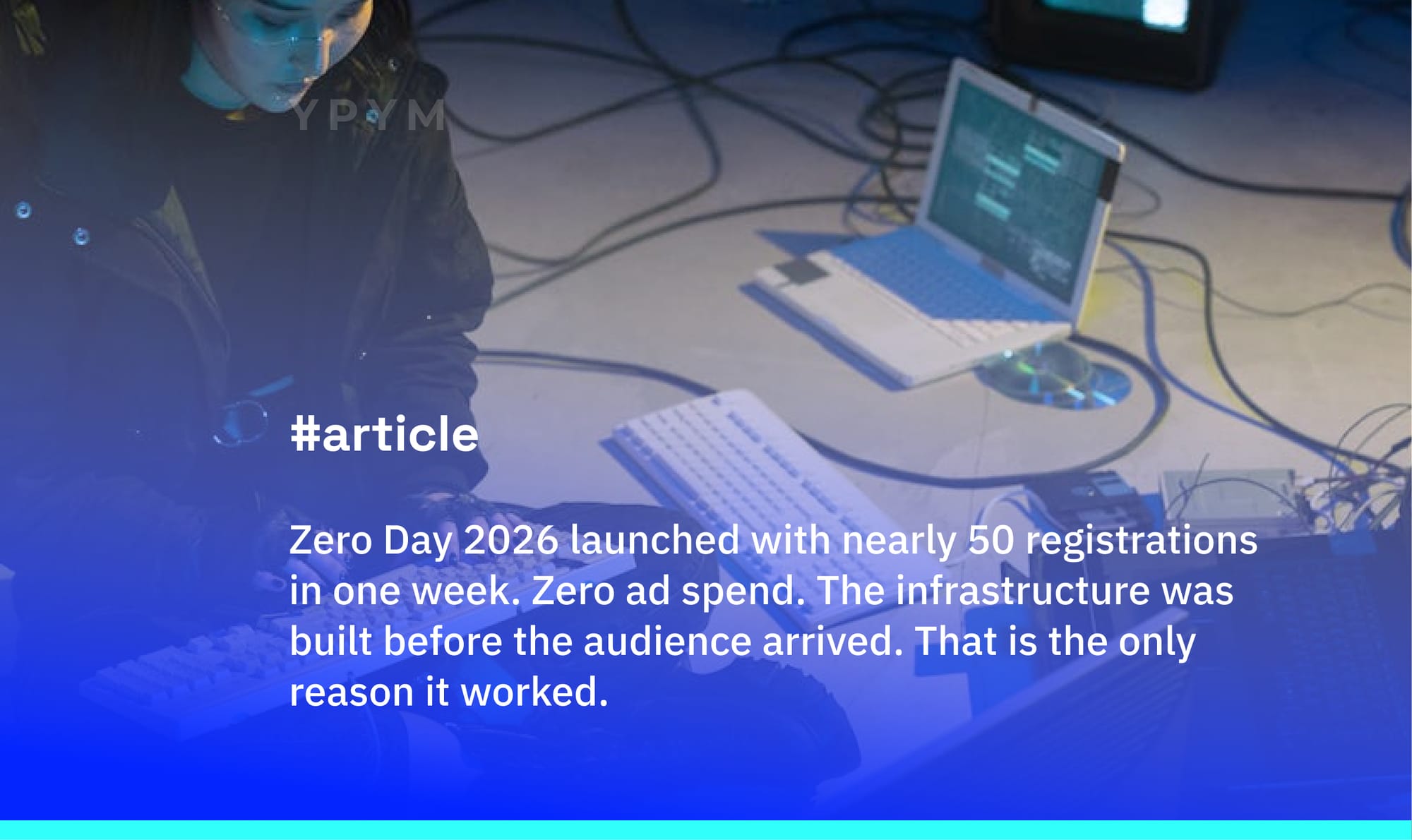
Today we activated the mini games stage for Zero Day 2026, a national Capture the Flag competition organized by DSG, open to students and the general public across all skill levels.
It is a cybersecurity event with a total prize pool of Rp40 million, targeting 300 to 500 registered infosec talents. The event is real, the competition is running, and as of this writing, we have nearly 50 registered participants who found their way to the registration page without a single rupiah spent on advertising.
I want to write about how that happened, because the mechanism is more instructive than the number.
The Decision Made Before the Event Was Announced
Most event marketing begins at the point of announcement. The organizer prepares a flyer, schedules a post, and publishes it with the expectation that reach will follow. This is a reasonable sequence. It is also the sequence that produces the most forgettable events.
What we did with Zero Day 2026 was structurally different, though not dramatically so. The difference was sequencing: we built the information architecture before we needed it to perform.
The first public signal was not a social media post. It was an official press release published on the DSG company website at digitalsolusigrup.co.id/hackathon-zero-day-2026, timestamped before the broader announcement went out. This page served a specific function: it gave every subsequent piece of content a credible, indexed, canonically correct source to point toward. When a LinkedIn post went live, it had somewhere authoritative to link. When the Instagram announcement published, the press release already existed as the formal record of the event.
The landing page itself, events.dsg.id/zero-day-2026, was the terminal node. Every piece of content in the ecosystem was designed to eventually direct traffic there, whether the path was one click or three.
This is not a sophisticated strategy. It is a disciplined one. The sophistication is in the order of operations, not in the tools used.


How the Web Was Built
If you search "Zero Day DSG" or "Zero Day 2026" in Google today, you will find the landing page.
You will also find the press release, the LinkedIn publications from both the event account and my own profile, and the Instagram announcements from the DSG official account. Google AI Overview has indexed enough of this ecosystem to surface a structured answer to those queries.
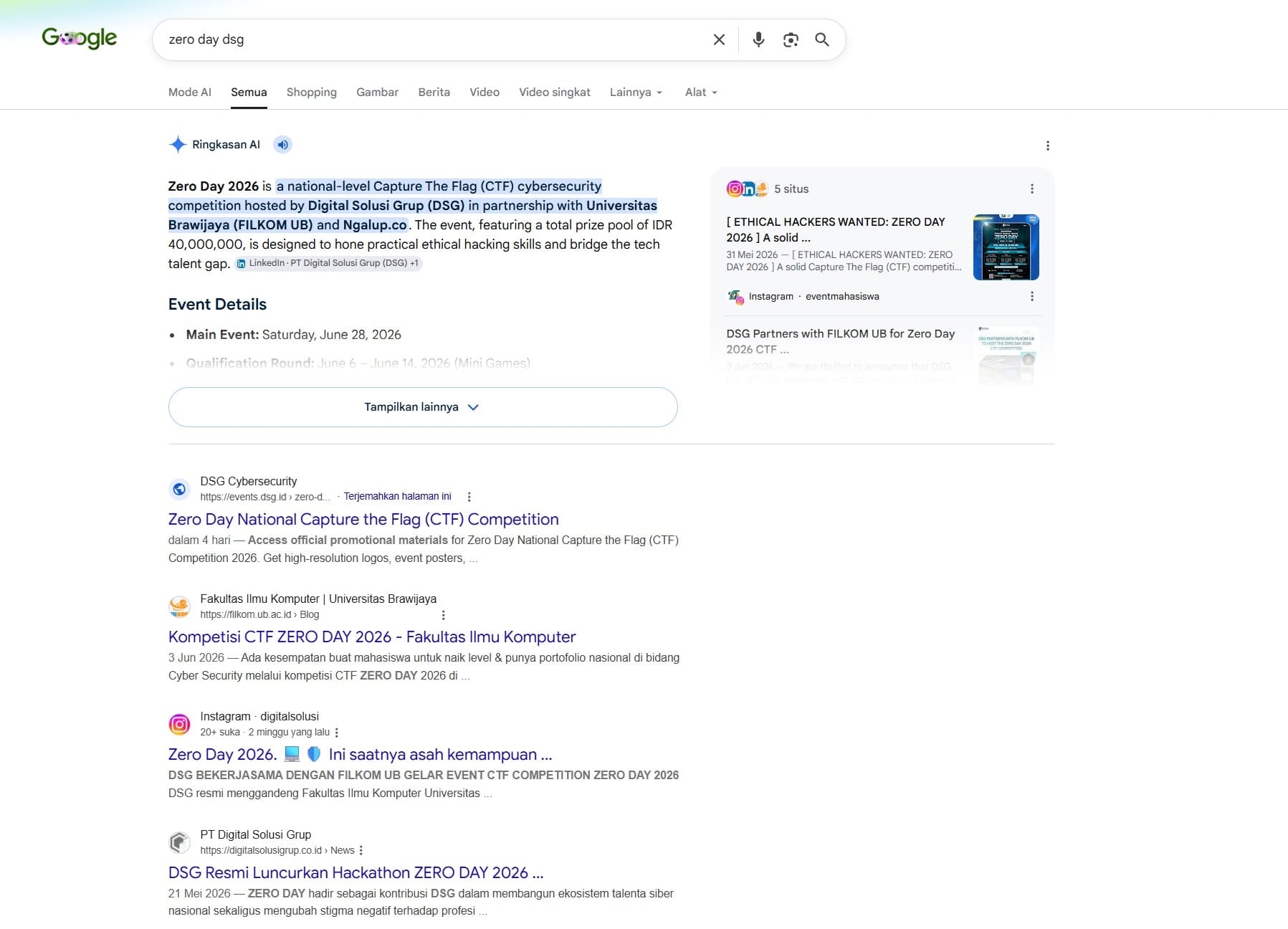
That outcome did not happen because we published a great post. It happened because each published asset was connected to the others in a way that made the intent of the entire ecosystem readable, to Google's crawler, to AI indexing agents, and to human users following the information chain.
The LinkedIn post from the official hackathon account functioned as an early authority signal, published under an account associated with specific professional credentials in cybersecurity and ethical hacking. My personal LinkedIn publication added an individual practitioner voice to the same information. The Instagram announcements reached a different distribution channel and created an additional indexed reference to the event. None of these assets was redundant. Each one addressed a slightly different discovery path.
The press release addressed the formal record. The social publications addressed distribution. The landing page addressed conversion. Each layer had one job.
The Offline Component That Amplifies the Online One
Digital architecture alone is rarely sufficient for an event that requires physical registration and real attendance. For Zero Day 2026, we also pursued collaborations with local media in East Java, with event ecosystem partners, and with educational institutions in Malang, where the event is anchored.
These collaborations served a function that no digital publishing can fully replicate: the legitimacy signal of institutions that exist in the physical world of the target audience. A student in Malang who sees their campus mention an event is not receiving a digital advertisement. They are receiving a trusted referral from a familiar authority. That referral then produces search behavior: they look up the event name, find the landing page in the first position, find the press release as supporting context, and register.
The organic search position captures demand that the offline conversation created. The offline conversation creates demand that would have been expensive, or impossible, to generate with digital advertising alone.
This is the actual meaning of the word "organic" in organic marketing. Not that it is free. It is not free. There are team hours, production costs, relationship management, and coordination effort embedded in everything described above. What it is, is structurally self-reinforcing. Each component makes the others more effective. The press release makes the LinkedIn post more credible. The educational institution mention creates search demand. The search demand finds the landing page in the position we built it to occupy.
What the Numbers Reflect
One week since the registration opened. Approximately 50 participants registered. Zero rupiah in advertising spend. Acquisition cost in terms of paid media: zero.
I want to be measured about what this means and what it does not mean. Fifty participants in one week for a national event that is still in its early registration phase is a functional start, not a final result. The event is designed to accommodate 200 to 300 registered infosec talents. Whether that target is reached will depend on how consistently the information ecosystem continues to function over the remaining registration period, and on how effectively the offline collaborations translate into registrations.
What the early number reflects is the efficiency of the acquisition channel, not the scale of the outcome. A paid advertising campaign that produced 50 registrations would have a calculable cost per registration. This campaign, in its paid media terms, has a cost per registration of zero. The cost that does exist, the team production cost, is a fixed internal cost that would have been incurred regardless of how many events we ran. It does not scale with registration volume.
This is the structural argument for organic marketing as a capital investment rather than a campaign. The infrastructure, once built and ranking, does not charge more for each additional user it converts. The marginal cost of the fiftieth registration is identical to the marginal cost of the five hundredth.
What This Has to Do With YPYM
Zero Day 2026 is not directly managed by YPYM. It is a DSG event in collaboration with me. But the architecture described in this article is precisely the architecture that YPYM is built to design, implement, and maintain for the organizations we work with.
The principle is consistent regardless of the context: a web page, or in this case a network of pages, is not a communication asset. It is a financial and operational one. It either occupies the positions it needs to occupy when the audience arrives looking for it, or it does not. The preparation determines the outcome. The outcome is then measured, not improvised.
For a CTF event with a Rp 40 million prize pool and national ambitions, the digital infrastructure described here was the appropriate investment. For a company with a product line, a service offering, or a market position to establish, the same logic applies at a different scale.
The page does the work. The question is whether the page was built to.
— Rochman Maarif researches the intersection of search, governance, artificial intelligence, and institutional trust. He believes sustainable visibility is earned through stronger standards, better systems, and long-term authority—not short-term optimization.
- Official CTF Event landing page https://events.dsg.id/zero-day-2026
- Official publication on LinkedIn https://www.linkedin.com/posts/rochman-maarif_zero-day-2026-by-dsg-ugcPost-7464588400352776192-vCM0/
- Official publication on Instagram https://www.instagram.com/p/DY7I_Y-E_ZX/
- Company press release https://digitalsolusigrup.co.id/hackathon-zero-day-2026/
- Company announcement on LinkedIn https://www.linkedin.com/posts/hackathonbydsg-cybersecurity-ethicalhacking-share-7462691719453564928-n2oS/
- Company announcement on Instagram https://www.instagram.com/p/DYizrLCE7g6/